

Per-environment scoping
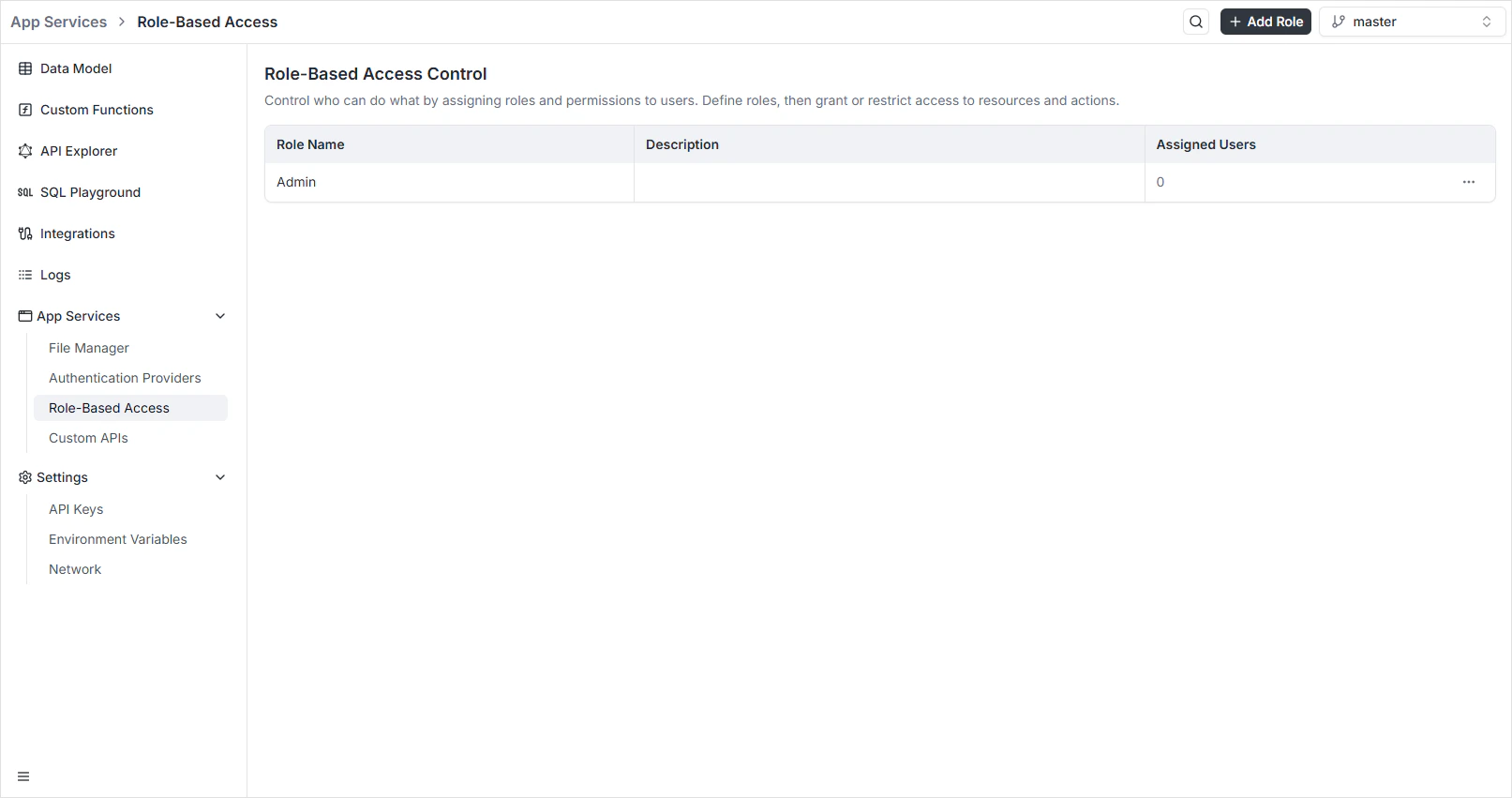
Roles are scoped per environment. Each environment has its ownroles table — switch environments and the roles list reflects whatever’s defined there. Branching an environment copies the roles in the source environment as a starting point.
Creating a role
1
Click + Add Role
The button sits in the top-right of the dashboard.
2
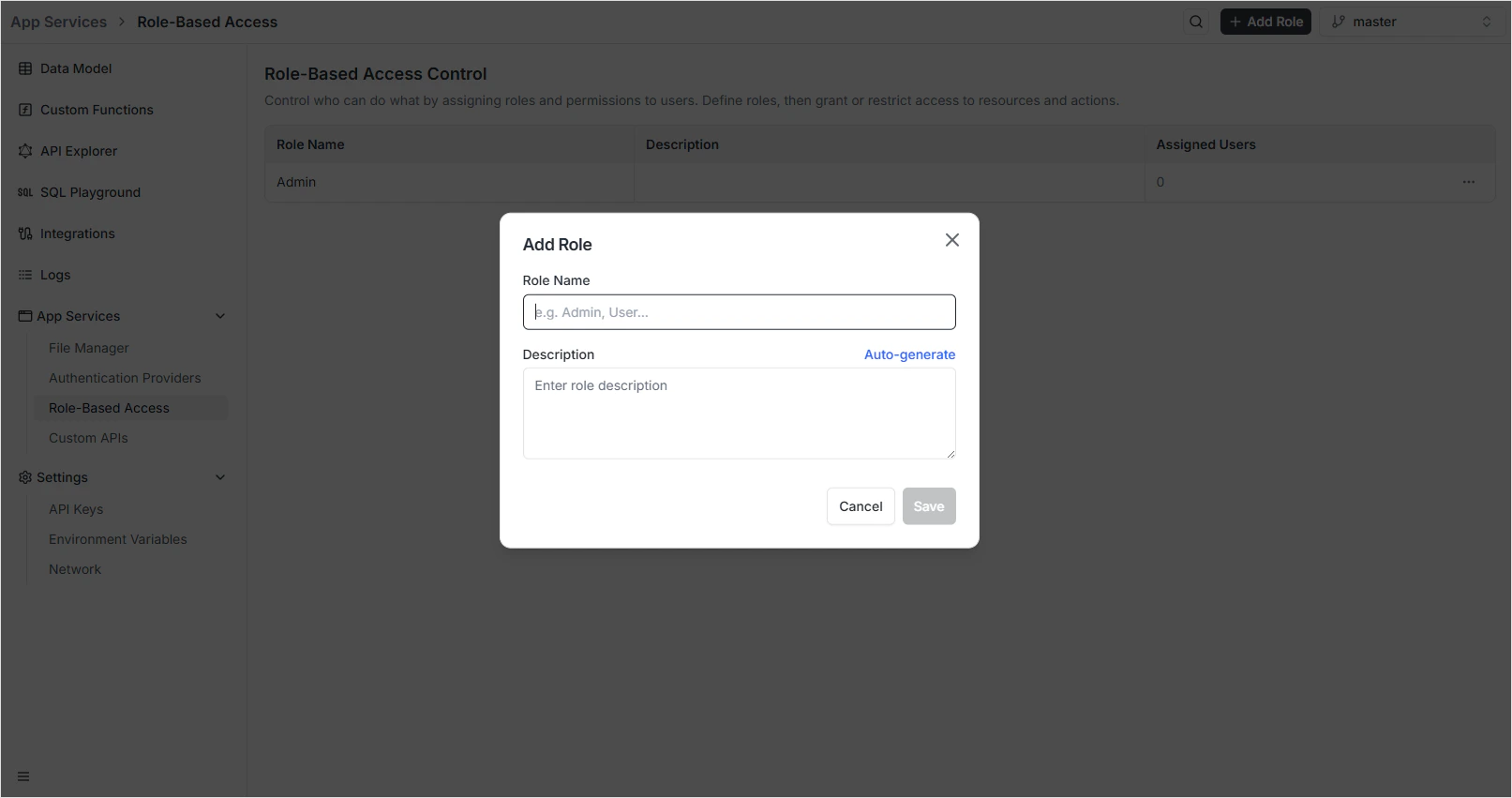
Name the role
Use a unique, snake-cased identifier —
admin, editor, content_manager. The name appears in API responses and tokens.3
Add a description
Briefly describe what the role can do. Click Auto-generate to have Archie propose one based on the name.
4
Save
The role appears in the dashboard with zero assigned users and a blank permissions grid.
The permission matrix
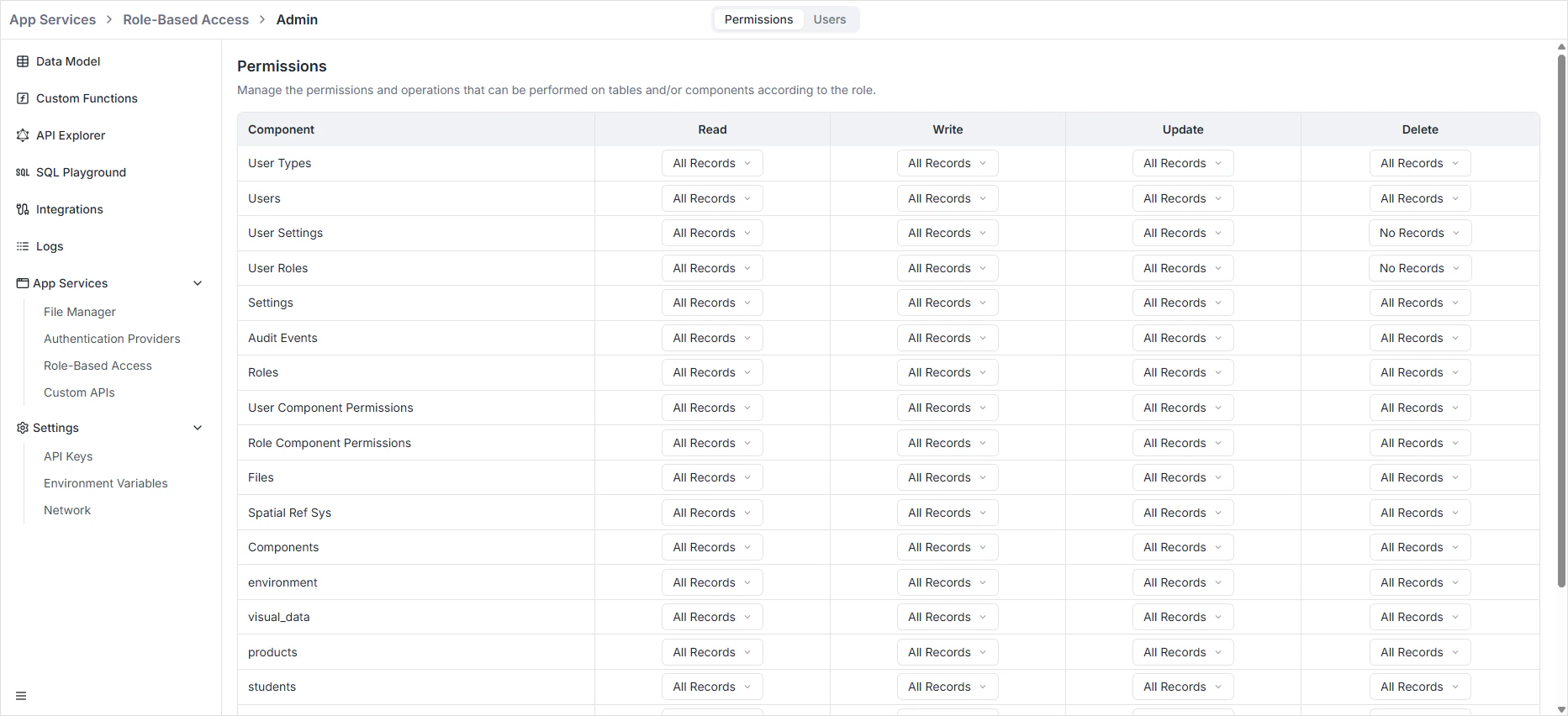
Click any role from the dashboard to open its permissions grid. For every resource — every table and every system resource — you toggle four operations:
The grid is the contract for both APIs — there is no separate “API permission” layer. Granting Read on
orders means a holder of this role can run query { orders { ... } } on GraphQL and GET /api/rest/orders on REST. Without it, both fail with 403 Forbidden.
Row-level filtering
The Filter column on each table scopes a role’s queries to a subset of records. You author it as a structured Custom Filter (a small JSON object) — for example, anemployee role that can only read records they own:
GET /api/rest/orders returns only the matching subset — the user never has to add anything to their request. Rules can reference the signed-in user ($user.id / $user.email), combine with AND / OR, and a user with multiple filtered roles sees the union of their filters.
Filters apply on top of the base permission: a role with Read on orders and a row-level filter can read its own orders; without Read, the filter doesn’t grant anything.
Row-Level Filters — full reference
All operators, per-user tokens, AND/OR logic, multi-role behavior, examples, and troubleshooting.
Roles and authenticated users
When a user signs in via an authentication provider, the issued token carries their assigned role(s). Every subsequent request is checked against those roles. Users can hold multiple roles; permissions are the union. Assignment happens in two places:- In the dashboard — open a user record (or the auth provider’s user list) and pick roles from the dropdown.
- At signup — pass a
roleIdto the Archie Auth signup endpoint. New users without an explicit role get the project’s default.
Roles and API keys
External clients calling the API use tokens generated under Backend → Settings → API Keys. When you create a key you attach one or more roles to it, and the key is bound to those permissions for its entire lifetime. To rotate the role attached to a key, generate a new key with the new role and revoke the old one. Roles assigned at key-creation time can’t be edited later — that’s deliberate, because a long-lived key whose permissions silently change is a security trap.Cross-cutting effects
FAQ
What's the default role for new users?
What's the default role for new users?
Each project has a default role assigned at signup time. By convention it’s a low-privilege role like
member — verified users get baseline read access to user-facing tables, nothing more. Configure it in the auth provider settings.Can I bypass RBAC for a custom function?
Can I bypass RBAC for a custom function?
Custom functions run with their own service identity. They can read and write tables regardless of the caller’s role — that’s typically the right place to enforce business-level rules that go beyond CRUD. The auto-generated APIs always enforce RBAC.
What does a row-level filter look like in practice?
What does a row-level filter look like in practice?
owner_id = $userId on the orders table means the user only sees their own orders, even when they call GET /api/rest/orders with no filter. The platform appends the filter to the WHERE clause server-side. The user can’t override it.If a user has multiple roles, what permissions do they get?
If a user has multiple roles, what permissions do they get?
The union — the most permissive across all assigned roles. If
editor has Read on posts and moderator has Update, a user with both can read and update.Can I copy roles from one environment to another?
Can I copy roles from one environment to another?
Yes — branching an environment optionally copies the roles. After branching, edits to roles in either environment are independent.